Compersion Etymology
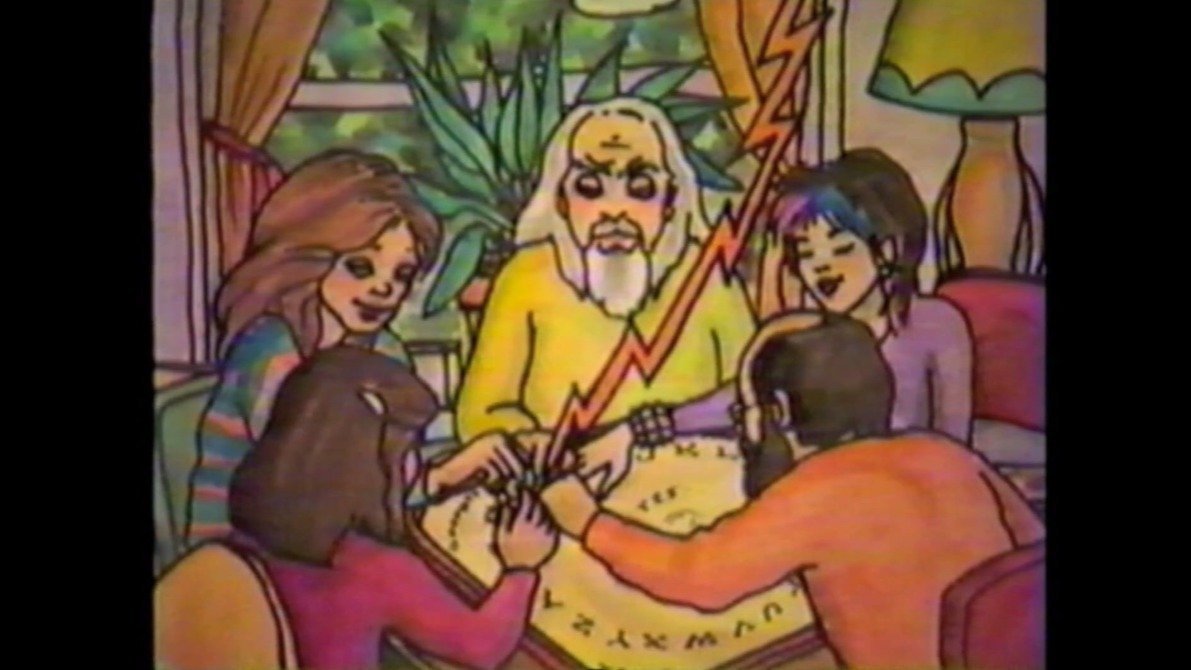
Illustration by Eve Furchgott
Blog authored by Maureen Burchert, aka Eden Zia & Shari Tresky, aka Tip Tye, who each lived at the Kerista Community for over a decade
The word “compersion” originated with the Kerista community in 1980. The Kerista community existed in the Haight-Ashbury neighborhood of San Francisco, California, from 1971 to 1991. There were, on average, 25 adult members of the community. The community practiced a form of ethical nonmonogamy they termed “polyfidelity,” defined as a closed group of best friends who are faithful to the group, live together, and share a family identity including sex, parenting, and pooled finances.
The Keristans often used an alphabet board to get advice and ideas about issues that were pertinent to the group at that time. (See illustrations above and below by Eve Furchgott and additional pictures below.) Like a Ouija board, participants would each grasp a part of an object, a cup for small groups or a circular planchette with sticks for larger groups, which would move to spell out messages and answers to questions posed. In video footage of the board being used, the cup (in this case) is lifted and placed down on each letter, as opposed to being slid like on a Ouija board. Some members would say the board was a way of communicating with their invented deities; some felt it was a form of telepathy between the people using the board; and others believed it was a form of brainstorming, similar to birds who fly in formation, taking cues from one another in a seamless process of nonverbal communication.
On November 28, 1980 fifteen Keristans were present for the board session when they asked the alphabet board for a word that described “the emotion that is the antonym of jealousy.” The answer was “compersion.” The notebook where they recorded their board sessions has been digitized and available on the Hamilton College archive website. The full transcript of this noteworthy session is archived at the Hamilton College Archive of Communal Societies, The Kerista Collection.
Little did they know at that time that this new word would end up in online dictionaries like Wiktionary/Wikipedia and Dictionary.com! Compersion became widely used in non-monogamous circles in the mid-1980’s soon after it was introduced by Ryam Nearing in “Loving More” magazine and conferences. The concept of compersion has become so popular that it is studied by social scientists and psychologists. Therapists are trained to work sensitively with people who are “poly,” so they may help them cultivate compersion in their relationships.
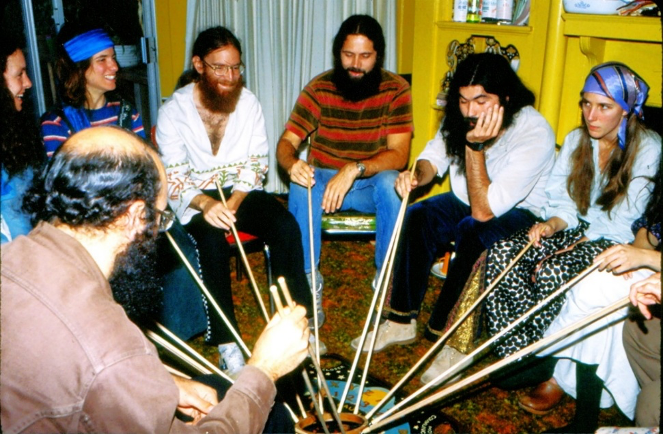
A group of Kerista community members during an alphabet board session, circa 1980
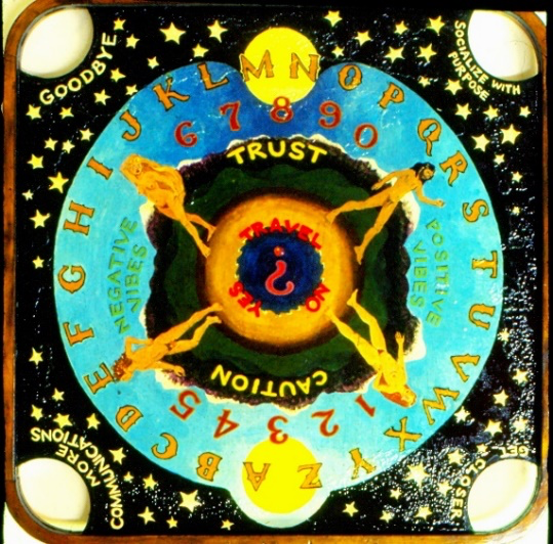
A photo of the actual alphabet board used. Designed and painted by Eve Furchgott.
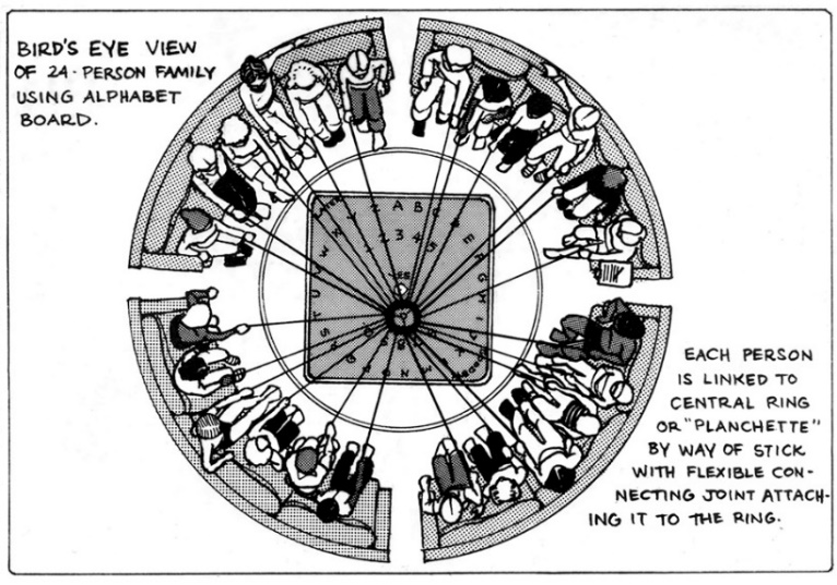
Eve Furchgott’s design and illustration for the alphabet board for use by up to 24 people.
Personal Experiences
Zia’s Story
I joined the Kerista community when I was 22 as a recent college graduate. I had moved to San Francisco looking for a hippy community and found it about 9 months later. I experienced compersion in various family groups throughout my 12 years as a member. One group was small, consisting of 2 women & 2 men, and one was larger, consisting of 7 women & 5 men. Compersion was my dominant relational emotion towards my partners. In my group, we were heterosexual, and we referred to our same sex partners as “starling” brothers or sisters. I enjoyed talking with my starling sisters about what they liked about our male partners. When I saw two of my partners having an intimate moment together, whether it was a private conversation or slipping off to a room together, it made me feel good and secure. I had occasional mild bouts of FOMO (fear of missing out) when two partners went off on a vacation together, but I could remedy that feeling by putting our own getaway on the calendar.

Context matters when it comes to experiencing compersion. I joined the community as a single woman looking for idealism, friendship and family. I wasn’t keen on monogamy or being in a couple. I wanted to create a better world and have a chosen extended family at the same time. Polyfidelity and utopian idealism were integral upfront standards of joining the community and the core beliefs that held us together.
Maureen Burchert, aka Eden Zia*, was a member of the Kerista Community from 1980 to 1991 and has many enduring friendships from the shared experience. She is retired and lives Berkeley, CA with her partner John working on a sailboat for eventual coastal cruising.
Tye’s Story
When I joined Kerista, I was 18 years old and I had very little experience in relationships. Yet I sensed I was “different” from a very early age. As a child, I remember feeling anxious when I imagined the “normal” path of marriage and children, and I knew that it was not for me.
When I read about Kerista, at age 16, it resonated immediately. My best friend and I had placed an ad in Mother Earth News, looking for a community, and someone sent us the community magazine, Utopian Eyes. I ended up joining the commune when I was 18, and I stayed until it dissolved about 15 years later. Even though we had lots of contradictions between our stated ideals and our actual behavior, we still managed to have a lot of fun. It was a choice that fit with my natural inclinations in many ways.
When the commune officially broke up, I continued to live in a polyfidelitous group for another few years. But it was just too challenging to make it work; we had too many conflicting desires and needs among the people involved. Still, even now, at 66 years old, I donʻt feel “at home” with societal norms and expectations. When I go to gatherings with other “straight” couples, I often feel awkward and self-conscious, and find it challenging to relate to people. My life may look more “normal” than before, with a boyfriend and a dog, but inside I still feel like an alien.
My emotional experience in Kerista was similar to Maureenʻs, I often felt compersion when relating to my partners, and I absolutely LOVED “girl talk about boys” with my starling sisters – maybe even more than my relationships with the men (although those were fun too)! I am not a lesbian, but the closeness I felt with my female partners was the closest I have ever felt with anyone in my life.
When everyone was together and happy with each other, I almost always felt joyful and secure, peaceful and content, even when I noticed certain members of the group having closeness and joy that I didnʻt share. As long as the group seemed stable and secure, I felt really happy in my individual relationships and I donʻt remember ever feeling jealous. But things felt very different when the group started coming apart.

There were times when – for various reasons – partners would leave the group in pairs, and at those times I felt emotions of hurt, jealousy, sadness and anger. I tried as best I could to adjust and still be friends, but it was really difficult, especially when I felt unreciprocated love for the people who had left. Over the years, I have also left people behind, so this is not to place any blame, but to explain the context when I felt compersion and the context when I felt threatened, insecure and jealous. Breakups are hard, whether you are in a couple or a group, but I would not trade those experiences for anything. I deeply value the precious friendships I have with my ex partners, who I still love as friends to this day.
Shari Tresky, aka Tip Tye*, was a member of the Kerista community from 1978-1991. She currently works as a mental health counselor and lives on a small farm in Hawai’i where she ponders the meaning of life while mowing grass, pulling weeds and digging in the dirt.
*We had acronym names in Kerista, Zia stands for ”Zen In All” and Tye stands for “Trust Your Essence”
